
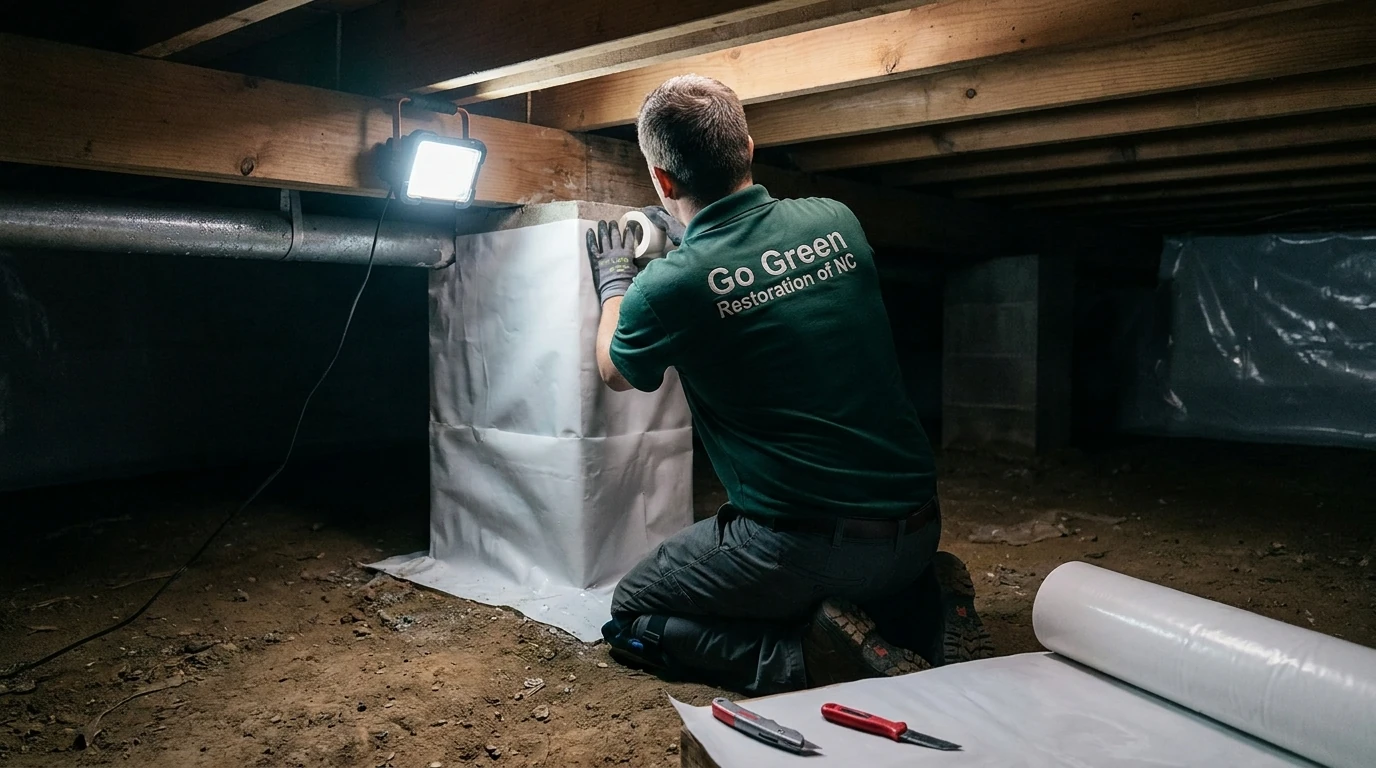
TL;DR: Crawlspace encapsulation means sealing the crawlspace with a heavy vapor barrier, insulating the walls, and controlling humidity with a dehumidifier or conditioned air, instead of leaving it open to outside moisture. In Smithfield, NC, where Neuse River humidity and low-lying streets push moisture up through open crawlspaces year-round, encapsulation typically runs $5,500 to $13,000 depending on square footage, drainage needs, and whether mold remediation is required first.
If your floors near Downtown Smithfield or West Smithfield feel cool and slightly spongy, or you’ve caught a musty smell drifting up through the floor vents since last spring’s heavy rain, your crawlspace is probably doing what open vented crawlspaces in this region do: pulling in humid outside air that condenses on cool floor joists. A torn vapor barrier or a bare dirt floor makes it worse. Encapsulation is the fix that stops the cycle instead of just treating the symptoms.
What Is Crawlspace Encapsulation?
Crawlspace encapsulation is the process of sealing a crawlspace from outside air and ground moisture using a reinforced polyethylene vapor barrier, sealed vents, and in most cases a dedicated dehumidifier. Instead of a vented crawlspace that breathes humid Johnston County air all summer, the space becomes a conditioned, controlled environment, similar to a basement.
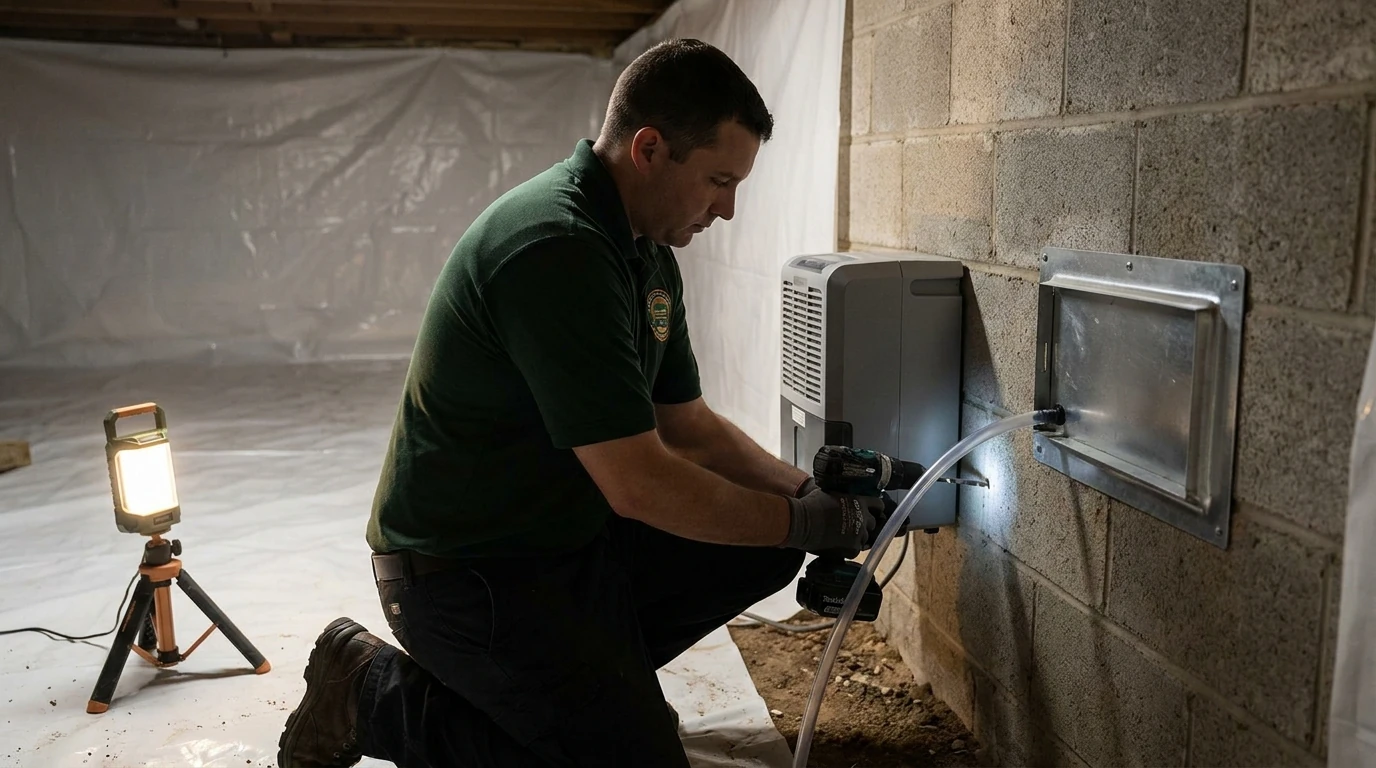
The barrier, usually 12 to 20 mil thick polyethylene, covers the dirt floor, runs up the foundation walls, and seals around piers and support posts with tape or mechanical fasteners. Crawlspace vents get closed off or replaced with sealed foam covers, and any existing gaps around plumbing or utility penetrations get sealed with spray foam or mastic. A standalone dehumidifier, sized to the square footage, keeps relative humidity under 55 percent year-round, which is the threshold the EPA cites as the point where mold growth becomes unlikely.
How Much Does Crawlspace Encapsulation Cost in Smithfield, NC?
Most Smithfield homeowners pay between $5,500 and $13,000 for a full encapsulation, with the number driven mostly by square footage, moisture severity, and whether existing mold has to be remediated before the barrier goes in. A small 1,000 square foot crawlspace with no standing water history lands on the low end; a larger home with a history of water intrusion, sagging insulation, and visible mold growth costs more because that work has to happen first.
A few things that move the price:
- Square footage and crawlspace height. Tighter, lower crawlspaces take longer to work in and cost more per square foot.
- Existing moisture damage. Rotted joists, sagging batt insulation, or mold on the subfloor add remediation and insulation replacement costs before encapsulation starts.
- Drainage needs. Homes near low-lying streets close to the Neuse River sometimes need a interior perimeter drain and sump pump added before the barrier goes down, since encapsulation alone doesn’t stop active water intrusion.
- Dehumidifier sizing. A crawlspace-rated dehumidifier with a condensate pump adds to the project but is what actually keeps humidity controlled after the barrier is installed.
Every crawlspace is different, which is why Go Green Restoration of NC provides a written scope and price after an on-site assessment rather than a number over the phone.
What’s Included in a Professional Crawlspace Encapsulation?
A professional encapsulation job moves through five phases: assessment, remediation (if needed), barrier installation, sealing, and dehumidification. Skipping any one of them is usually why a cheaper encapsulation fails within a year or two.
- Assessment. A technician checks moisture readings at the subfloor and foundation walls, looks for standing water history, checks existing insulation condition, and tests for visible mold.
- Remediation, if needed. Wet or moldy insulation gets removed, any active mold gets treated per industry guidance before sealing anything in, and damaged wood is flagged for repair.
- Vapor barrier installation. The polyethylene sheeting goes down over the dirt floor, up the foundation walls, and around every pier, with seams taped and overlapped so there are no gaps.
- Sealing vents and penetrations. Foundation vents get sealed or replaced, and any gaps around plumbing, wiring, or HVAC lines get closed with foam or mastic.
- Dehumidification. A crawlspace-rated unit with an automatic condensate drain or pump gets installed and set to maintain humidity below the threshold where mold and wood rot take hold.
If your crawlspace already has water intrusion history, read Water in Crawl Space After Heavy Rain: What to Do Before Mold Moves In for what to do in the meantime, since encapsulation isn’t a substitute for fixing an active leak.
Is Crawlspace Encapsulation Worth It Near the Neuse River?
For homes in Smithfield and West Smithfield close to the Neuse River, encapsulation is usually worth it because the ground moisture problem here is persistent, not occasional. Properties on low-lying streets near the Smithfield Neuse Riverwalk see groundwater push up through vented crawlspaces for weeks after a heavy rain event, which keeps humidity high long after the storm passes.
That sustained humidity is what drives the mold calls Go Green Restoration of NC sees most often in older Johnston County housing stock, where crawlspaces were built vented per older code and never updated. An encapsulated crawlspace with a dehumidifier holds a stable humidity level no matter what’s happening outside, which protects subfloor wood, HVAC ductwork, and indoor air quality at the same time.
It’s a different calculation for a newer build on higher ground with no moisture history. In that case, encapsulation is more of a preventive upgrade than an urgent fix, and the payback shows up more in energy savings and comfort than in stopping an active problem.
What Should You Do Next?
Start with a moisture assessment, not a quote off a phone call, since the right scope depends on what’s actually happening under your floor right now. A technician checking humidity levels, insulation condition, and any existing mold will tell you whether you need remediation first or can go straight to encapsulation.
If you’re also dealing with insulation that’s wet, sagging, or showing mold, that gets addressed in the same visit, and you can see how that pairs with encapsulation in Attic and Crawl Space Insulation Removal and Install in Zebulon, NC.
A crawlspace that’s been quietly feeding humidity into your home for years doesn’t fix itself, and the cost of waiting usually shows up later as a mold remediation bill or rotted subfloor repair. Go Green Restoration of NC schedules crawlspace assessments across Smithfield and the surrounding Johnston County communities, with crews that can move straight from assessment to remediation to encapsulation without bringing in a second contractor.
About Go Green Restoration of NC
Go Green Restoration of NC is based in Middlesex, NC and serves homeowners and property managers across Smithfield, Raleigh, Durham, Wilson, Rocky Mount, and the surrounding Johnston and Nash County communities. The company operates on a 24/7 availability basis and handles crawlspace encapsulation, mold remediation, water damage restoration, and insulation removal and installation, among other restoration and reconstruction services, with a written scope provided before work begins on every job.