
Mold Remediation in Clayton
24/7 mold remediation in Clayton, NC. Insurance billing accepted. Call (919) 906-5473.
Our technicians are dispatched from our Middlesex, NC headquarters and are typically on-site in Clayton within 60 minutes of your call.
Mold doesn’t wait for a convenient season in Clayton. Johnston County’s humid summers and the moisture load that comes with a fast-growing town full of crawlspace-foundation homes mean mold spores find an opening fast, usually behind a water heater, under a bathroom vanity, or in a crawlspace vapor barrier that’s torn or missing. If you’re smelling something musty in a closet or seeing dark speckling creep across drywall, the window between “small problem” and “remediation job” is shorter than most homeowners expect.
Why Clayton Properties See Mold Issues
Clayton sits in the Piedmont, where clay-heavy soil doesn’t drain the way sandy coastal soil does. After a heavy rain, water sits near foundations longer than homeowners expect, and that moisture finds its way into crawlspaces through grade slope issues or aging vapor barriers. The town’s rapid growth over the past two decades means a mix of building stock: newer subdivisions with tight, well-insulated construction that traps humidity if ventilation is undersized, and older homes closer to downtown Clayton with original ductwork and plumbing that’s had more time to develop slow leaks. Both patterns lead to the same result: moisture sitting somewhere it shouldn’t, usually in places you can’t see without opening up a wall or crawling under the house.
Humidity itself is a factor independent of any leak. A Piedmont summer with consistent dew points in the 60s and 70s keeps relative humidity high enough, especially in crawlspaces and attics, that mold can colonize on organic material (wood framing, insulation paper, cardboard storage boxes) without a single plumbing failure involved.
Our Mold Remediation Process in Clayton
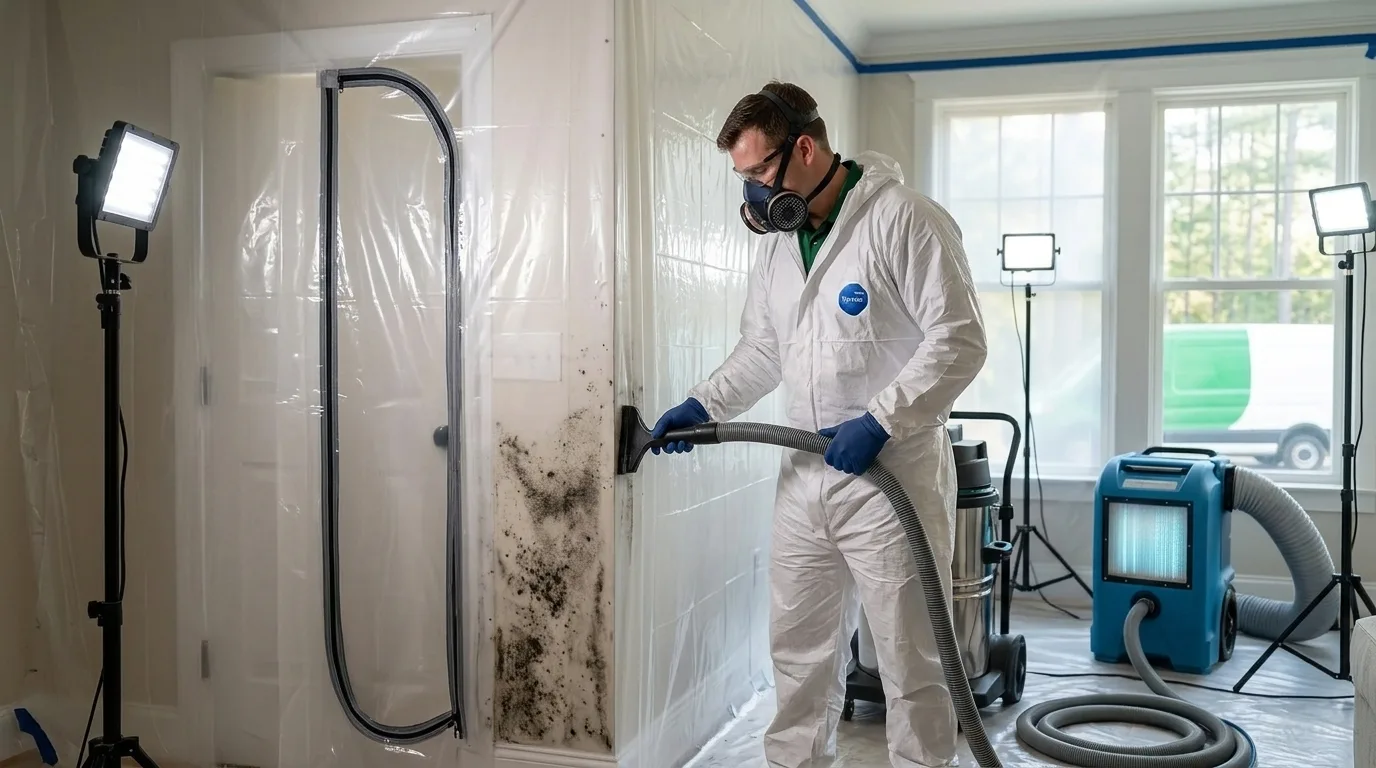
Every job starts with identifying the moisture source, not just the visible growth, because treating mold without stopping what’s feeding it means the colony returns. For crawlspace jobs common in this area, that often means assessing the vapor barrier and any standing water before remediation begins. Once the source is addressed, we isolate the work area with physical containment and negative air pressure so spores don’t migrate into living space through HVAC returns or door gaps, a real risk in the open floor plans typical of newer Clayton construction. Affected materials that can’t be cleaned, like saturated drywall or insulation, are removed and bagged for disposal. Remaining surfaces are treated with antimicrobial solution and HEPA-vacuumed, and air scrubbers run through the containment zone until particle counts come back down, all following the IICRC S520 standard for mold remediation work.
For homes with HVAC-driven cross-contamination, that is, mold spores that have traveled through supply or return ducts, we evaluate whether duct cleaning needs to happen alongside the remediation. Skipping that step is one of the most common reasons homeowners see mold return in a different room a few months later.
Clayton Insurance & HOA Coordination
Mold claims are handled differently than most water damage claims. Many policies exclude mold unless it stems from a “covered peril,” like a sudden pipe burst rather than long-term humidity or a slow, undetected leak, so documentation matters. We photograph the source, the extent of growth, and the materials removed, and we provide that paperwork in a format carriers can work with. For homes in Clayton’s newer planned communities, some HOAs also require notification or documentation before exterior work, crawlspace access changes, or dumpster placement during a remediation job, and we coordinate that piece so it doesn’t hold up the schedule.
Local note
One detail that catches first-time homeowners off guard in Clayton: a lot of the area’s housing stock, especially in subdivisions built since the early 2000s, uses engineered wood floor joists over a crawlspace rather than a slab. Those joists can show mold growth on the underside well before anything is visible from inside the house, because the crawlspace stays several degrees cooler and more humid than the living space above it. A musty smell on the main floor is frequently a sign that the real problem has been developing in the crawlspace for weeks.
If you’ve noticed that smell, seen staining on drywall or baseboards, or had a crawlspace inspection flag moisture, it’s worth having someone look before the colony spreads further through framing or insulation. Go Green Restoration of NC answers calls around the clock and works directly with Clayton homeowners and property managers to scope the problem, contain it, and document it properly for insurance. Call (919) 906-5473 to get a remediation plan started.
Mold Remediation in Clayton: Service Coverage
Frequently Asked Questions
How fast can you arrive for mold remediation in Clayton?
Are Clayton's newer subdivision homes more prone to mold than older downtown homes?
Why does mold keep coming back in my Clayton crawlspace even after cleaning?
Does my Clayton HOA need to be notified before mold remediation work?
What does mold remediation actually involve, step by step?
Will my insurance cover mold remediation in Clayton?
Mold Remediation response in Clayton
Most Clayton calls see a technician on-site within 60 minutes from our Middlesex headquarters.