
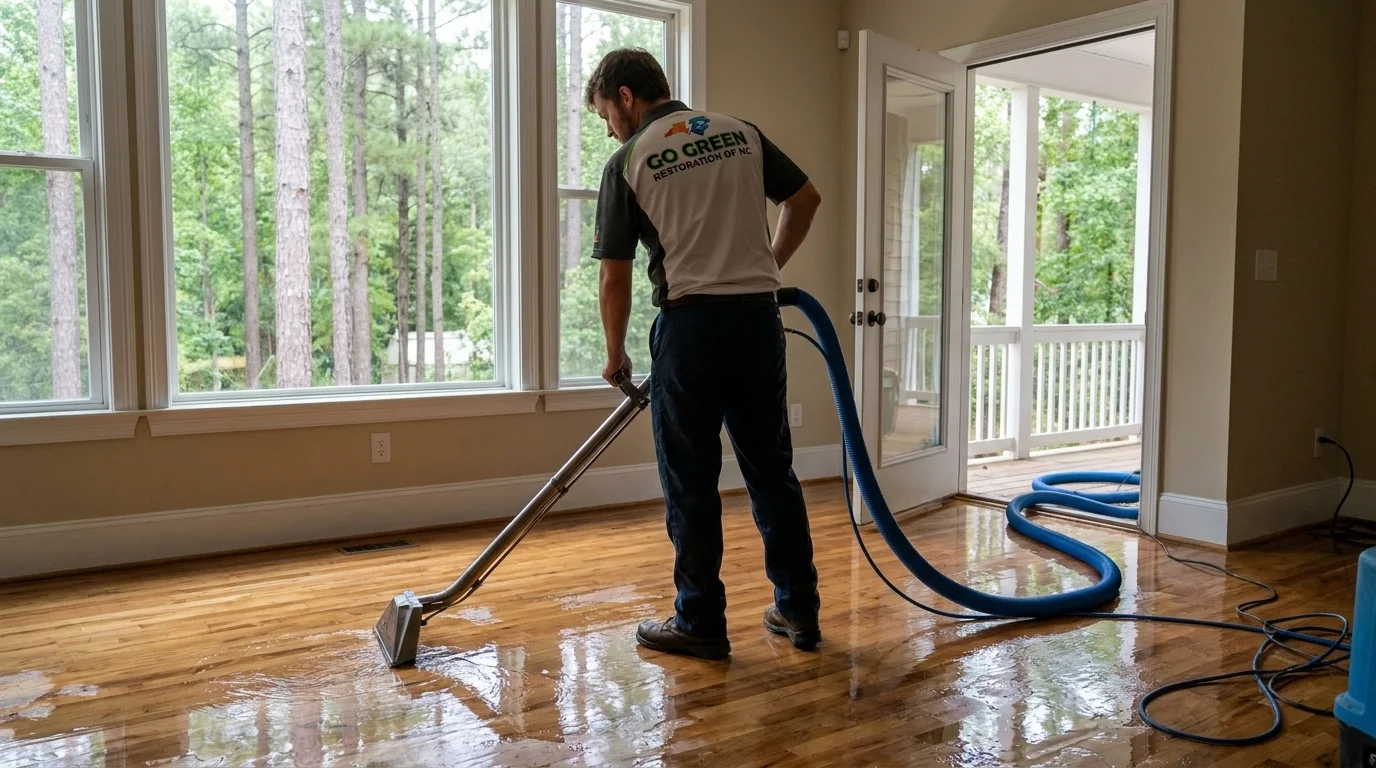
24/7 Emergency Flood Damage Restoration in Middlesex
24/7 emergency flood damage restoration in Middlesex and surrounding areas. Insurance billing accepted. Call (919) 906-5473.
Flooding in Middlesex doesn’t behave like a burst pipe. When storm runoff, a overflowing creek, or a saturated septic field pushes water into a home, you’re usually dealing with standing water that carries silt, fertilizer runoff, or sewage, not clean supply-line water. That distinction changes everything about how the loss gets cleaned, what gets torn out, and how fast mold risk climbs. We answer 24/7, and because Hours are 24/7 we can get a crew moving the same day a storm clears.
What Flood Damage Restoration actually involves
Flood damage restoration deals with water that originated outside the home’s plumbing system: overland flooding, storm surge, a failed sump pump during heavy rain, or groundwater forced up through a slab. The water is almost always classified as Category 3 (grossly contaminated) under the IICRC S500 standard, which means porous materials it touches, carpet pad, drywall below the flood line, insulation, baseboards, generally cannot be dried in place and have to come out. Crews work with submersible pumps and truck-mount extractors for standing water, then move to air movers, low-grain-refrigerant dehumidifiers, and antimicrobial application once the bulk water is gone. On a single-story home with a few inches of floodwater, expect demolition and extraction within the first day, then 3 to 5 days of monitored drying before rebuild can start.
Our process
- Water categorization and safety check. We confirm the water source and contamination level before anyone steps inside, since flood water can hide electrical hazards, structural weakening, or sewage backflow.
- Extraction and controlled demolition. Standing water comes out first with pumps and extractors, followed by removal of saturated drywall (typically cut 12 to 18 inches above the flood line), ruined flooring, and insulation that can’t be salvaged.
- Muck-out and antimicrobial treatment. Silt, mud, and debris left behind by floodwater get cleared and surfaces are treated with an EPA-registered antimicrobial to address contamination before drying begins.
- Structural drying with daily monitoring. Air movers and dehumidifiers run on a calculated drying plan, with moisture readings logged in wall cavities, subfloor, and framing until materials hit dry standard, not just “looks dry.”
- Documentation handoff. Photos, moisture logs, and a scope of work are compiled for your adjuster or flood insurance carrier before any rebuild begins.
What separates a good flood damage response from a bad one
The most common shortcut is drying floodwater like it’s a clean-water leak, running fans over contaminated carpet pad instead of removing it. That leaves bacteria and organic matter trapped in materials that will smell and degrade for months. Another frequent miss is stopping the drywall cut at the visible waterline instead of a few inches above it, which ignores wicking, the way water climbs through gypsum board by capillary action well past where it looks wet. Adjusters reviewing a flood claim look for moisture-mapping documentation at the start and end of drying, photos of contaminated materials before removal, and a clear line between what was dried in place versus demolished. Crews that skip daily monitoring often sign off on “dry” too early, and secondary mold claims a few weeks later are far more expensive than finishing the job right the first time.
What does Flood Damage Restoration cost?
Costs vary widely based on how much water entered the home, how long it sat before extraction, and how much demolition is needed. Every loss gets a written scope before work begins so there are no surprises, and these figures are typical industry ranges, not a quote for your property. Standard homeowners insurance usually excludes flood water from an outside source, which is why many Middlesex-area homeowners carry a separate flood policy through the NFIP or a private flood carrier; we document the loss either way so you can file with the right policy.
| Scenario | Typical range |
|---|---|
| Single room, shallow floodwater, minimal demolition | $1,800 - $4,000 |
| Whole first floor, standing water, drywall and flooring removal | $8,000 - $18,000 |
| Crawlspace flooding with insulation and subfloor damage | $3,500 - $9,000 |
| Basement flood with contents loss and muck-out | $6,000 - $15,000 |
| Whole-home flood with structural drying and rebuild | $20,000 and up |
Seasonal & regional considerations
Eastern North Carolina sees its heaviest flood risk during late-summer tropical systems, when saturated ground and swollen creeks push water into homes that rarely see it the rest of the year. Many properties around Middlesex sit on well and septic systems, which means floodwater can carry septic contamination in addition to storm runoff, something crews account for when setting the demolition line and choosing antimicrobial treatment.
Service area
We respond to flood damage calls from our Middlesex headquarters out to Zebulon, Wilson, Knightdale, and the surrounding Johnston and Wilson County communities, where older homes on crawlspaces and low-lying lots see the most frequent flood intrusion.
If floodwater has already entered your home, don’t wait on the drywall to “dry out on its own,” contaminated materials left in place only get more expensive to deal with. Call (919) 906-5473 to schedule flood cleanup and get a written scope started today.
Frequently Asked Questions
Does homeowners insurance cover flood damage restoration?
Why does flood water require more demolition than a burst pipe?
How high up the wall do you need to cut drywall after a flood?
How long does flood cleanup take before a home is dry?
What should I do with furniture and belongings while waiting for a flood crew?
Looking for the best flood damage restoration company in Middlesex?
Go Green Restoration of NC provides flood damage restoration in Middlesex, NC and the surrounding area. We answer calls 24/7 — call (919) 906-5473 for immediate help.
Need Flood Damage Restoration now?
We respond 24/7 across Middlesex and surrounding NC cities.
Related Coverage
- Our Restoration Services
- Contact Go Green Restoration of NC
- Restoration Services in Archer Lodge
- Restoration Services in Clayton
- Restoration Services in Durham
- Restoration Services in Elm City
- Restoration Services in Kenly
- Restoration Services in Knightdale
- Restoration Services in Lake Royale
- Restoration Services in Louisburg
- Restoration Services in Nashville
- Restoration Services in Pine Level
- Restoration Services in Raleigh
- Restoration Services in Rocky Mount