
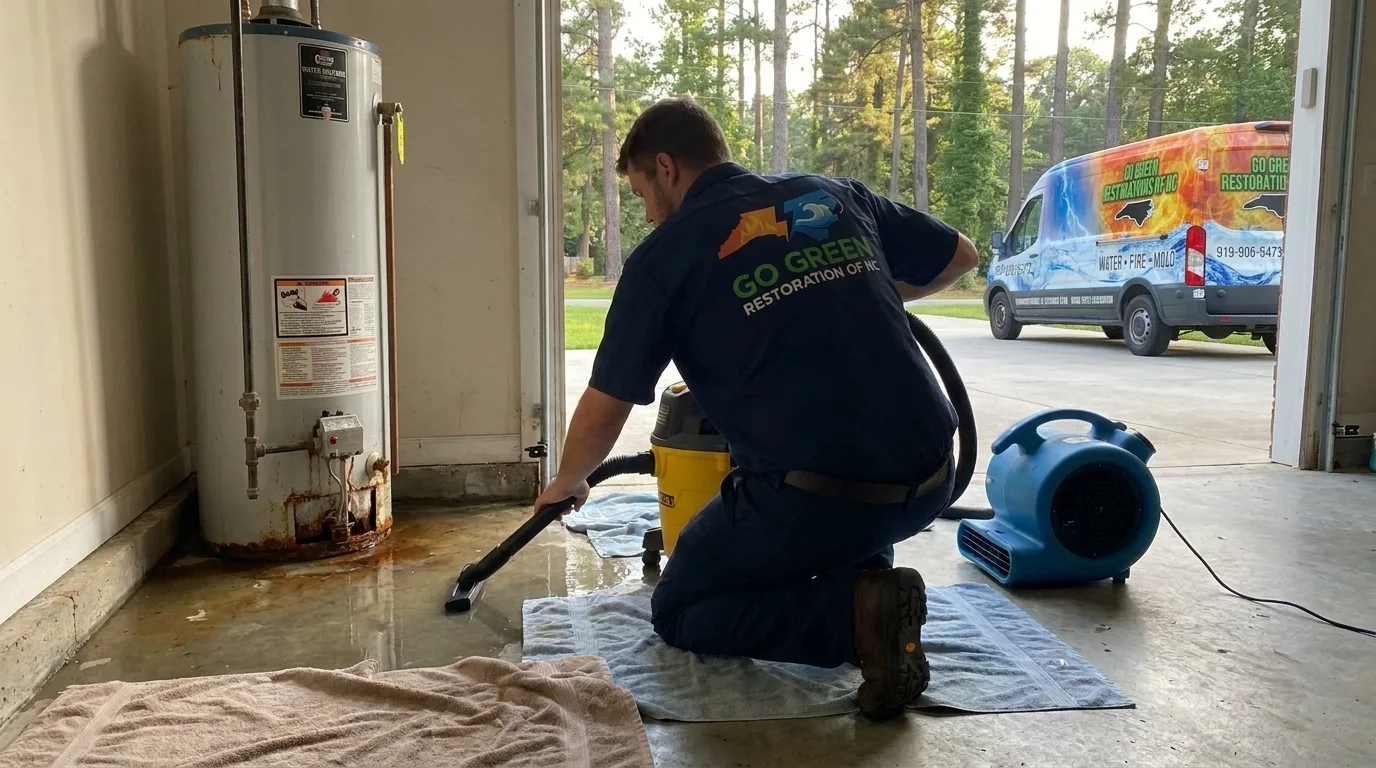
24/7 Emergency Water Heater Flood Cleanup in Middlesex
24/7 emergency water heater flood cleanup in Middlesex and surrounding areas. Insurance billing accepted. Call (919) 906-5473.
Water heater flood cleanup in Middlesex? A failed tank or burst supply line can put dozens of gallons on the floor in minutes, and the damage often spreads into a wall cavity or subfloor before anyone notices. We answer 24/7, because a leaking water heater rarely waits for business hours and the longer standing water sits against drywall, insulation, or wood flooring, the more expensive the repair becomes.
What Water Heater Flood Cleanup actually involves
Most water heater floods fall into one of two patterns: a slow leak from a corroded tank seam or fitting that’s been dripping for days, or a sudden rupture that dumps the full tank volume at once. Either way, the water is usually treated as clean (Category 1) unless it’s been sitting long enough to pick up contaminants from flooring materials or has mixed with sediment and rust from an aging tank. Cleanup starts with stopping the source, then moves into extraction, moisture mapping, and structural drying using commercial air movers and dehumidifiers. Because water heaters are frequently tucked into closets, garages, attics, or crawlspaces, a lot of the damage is hidden behind doors or under flooring where homeowners don’t look until there’s a smell or a soft spot underfoot.
Our process
- Shut-off and source control. We confirm the water supply and, where applicable, the gas or electric power to the unit is off before anyone steps into standing water near an active appliance.
- Extraction and damage assessment. Standing water gets pulled first, then we check the subfloor, baseboards, and adjacent wall cavities for wicking, since water heater floods often travel further than the visible puddle suggests.
- Containment and drying setup. Air movers and dehumidifiers go in, positioned around the water heater closet or utility space, with moisture readings logged at the start so we have a baseline to compare against.
- Monitoring and secondary damage checks. We watch for rust staining, mineral scale, and corrosion on nearby metal fixtures or framing, which can keep causing problems even after the area reads dry.
- Final moisture verification. Once materials hit a dry standard, we document final readings so the space is ready for flooring repair or tank replacement without trapped moisture behind the walls.
What separates a good water heater flood response from a bad one
The most common mistake is treating a water heater leak like a mop-and-done job. Surface water gets wiped up, the floor looks fine in a day, and nobody checks whether the subfloor underneath the vinyl or the drywall behind the unit actually dried out. Water heaters are often installed in closets with poor airflow, so a cavity that looks dry at the surface can stay damp for a week and start growing mold without anyone smelling it until it’s already spread into adjoining rooms. Adjusters reviewing these claims generally want to see moisture readings taken at the time of loss, documentation of the source (a failed tank, a corroded fitting, a supply line), and a drying log showing the affected materials actually reached a dry standard rather than just looking dry. Skipping that documentation is one of the fastest ways a claim gets delayed or reduced.
What does Water Heater Flood Cleanup cost?
Costs vary a lot depending on whether the leak was caught early or ran for days, how far the water traveled, and whether flooring or drywall needs to be replaced. These are typical industry ranges, not a quote: every loss is different, and Go Green Restoration of NC provides a written scope of work before any cleanup begins. Most homeowners insurance policies cover sudden water heater failures (a burst tank or fitting) but may exclude damage from a leak that went unaddressed for an extended period due to neglect, so it’s worth reviewing your policy language.
| Scenario | Typical range |
|---|---|
| Small leak, caught early, clean water only | $500 - $1,500 |
| Burst tank, single room affected | $1,500 - $4,000 |
| Multi-room flooding with flooring replacement | $4,000 - $9,000 |
| Wall cavity and drywall saturation | $3,000 - $7,000 |
| Undetected leak with mold onset (72+ hours) | $5,000 - $12,000 |
Seasonal & regional considerations
Many homes around Middlesex and the surrounding county still have water heaters tucked into crawlspaces or unconditioned garages, where humidity swings between a muggy North Carolina summer and a damp winter make it harder for a slow leak to dry on its own. Water heater demand and failure rates tend to climb in the colder months as units work harder, which is also when a leak in a crawlspace is least likely to be noticed right away. Summer humidity, meanwhile, slows natural evaporation, so a leak that would dry out in a few days during a dry spell can linger and start supporting mold growth within that same window.
Service area
We respond to water heater flood cleanup calls throughout Middlesex and nearby communities across Nash, Wilson, and Johnston counties, including homes with older crawlspace installations and newer construction with closet or garage units.
If your water heater is leaking, has already burst, or you’ve found a damp spot near the unit that won’t go away, call (919) 906-5473 to start water heater flood cleanup before the damage spreads further into your floors and walls.
Frequently Asked Questions
Does homeowners insurance cover water heater flood cleanup?
How do I know if my water heater is actually leaking versus just condensation?
What happens if a water heater leak goes undetected for a few days?
Should I shut off my water heater myself before help arrives?
Can a leaking water heater damage areas beyond the immediate floor?
Looking for the best water heater flood cleanup company in Middlesex?
Go Green Restoration of NC provides water heater flood cleanup in Middlesex, NC and the surrounding area. We answer calls 24/7 — call (919) 906-5473 for immediate help.
Need Water Heater Flood Cleanup now?
We respond 24/7 across Middlesex and surrounding NC cities.
Related Coverage
- Our Restoration Services
- Contact Go Green Restoration of NC
- Restoration Services in Archer Lodge
- Restoration Services in Clayton
- Restoration Services in Durham
- Restoration Services in Elm City
- Restoration Services in Kenly
- Restoration Services in Knightdale
- Restoration Services in Lake Royale
- Restoration Services in Louisburg
- Restoration Services in Nashville
- Restoration Services in Pine Level
- Restoration Services in Raleigh
- Restoration Services in Rocky Mount